Back to home
INTERNATIONAL2 July 2026
The Vatican’s Mass Excommunication: A Theological Schism Revisited
The Vatican has announced the excommunication of roughly 600,000 members of the Society of Saint Pius X, a traditionalist Catholic group, highlighting a deepening divide within the Church. This unprecedented move underscores Pope Francis’s resolve to enforce canonical unity.
La
La Rédaction
The Vertex
5 min read
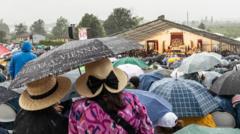
Source: www.bbc.co.uk
In a landmark decision announced on July 2, 2026, the Vatican confirmed the excommunication of approximately 600,000 members of the Society of Saint Pius X (SSPX), a schismatic Catholic grouping that has long resisted the reforms of the Second Vatican Council. The move, unprecedented in its scale, signals a decisive turn by Pope Francis toward enforcing canonical unity after years of uneasy dialogue.
The SSPX, founded in 1970 by Archbishop Marcel Lefebvre, rejects the legitimacy of the post‑Vatican II Church, arguing that certain liturgical and doctrinal changes compromise core Catholic teaching. Its massive following, concentrated in Europe, Latin America, and parts of Asia, reflects a deep yearning for traditional worship and hierarchy. By excommunicating these faithful, the Holy See underscores that allegiance to the Pope is non‑negotiable, reasserting the authority of the magisterium over personal or regional interpretations of doctrine.
Historically, the Vatican has employed excommunication as both a warning and a tool of reconciliation, as seen in the 1992 lifting of the SSPX’s automatic excommunication for four bishops. Yet the current decree, targeting the laity rather than the hierarchy, marks a stricter stance, reflecting Pope Francis’s broader agenda to curb fragmentation within a globally diverse Church.
The repercussions extend beyond theological debate; they affect pastoral care, education, and the social services run by SSPX communities. While some faithful may seek reunion under the papal banner, others may withdraw further into isolation, reinforcing a parallel ecclesial structure. The episode thus foreshadows a more polarized Catholic landscape, where the tension between continuity and reform will continue to shape the Church’s future.