Back to home
INTERNATIONAL4 July 2026
Strategic Sabotage: Ukraine's Strike on Russia's St. Petersburg Oil Hub
Ukrainian President Volodymyr Zelensky confirmed that a strike on a major oil terminal in St. Petersburg targeted revenue‑generating infrastructure for Russia’s war effort, highlighting a new strategic focus on energy assets.
La
La Rédaction
The Vertex
5 min read
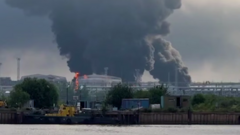
Source: www.bbc.co.uk
On 4 July 2026, Ukrainian President Volodymyr Zelensky announced that Ukrainian forces had struck a major oil terminal in St. Petersburg, Russia’s second‑largest city. The attack, carried out with a combination of drones and long‑range missiles, targeted the facility’s storage tanks and loading infrastructure, causing visible damage and a temporary halt to operations.
The terminal processes a significant portion of Russia’s exported crude and fuels, generating substantial revenue that underwrites the Kremlin’s war effort. By disrupting this node, Kyiv aims to choke a financial lifeline that funds artillery, ammunition, and logistical support for the front lines. Analysts note that even a short‑term outage can create ripple effects across global oil markets, raising prices and prompting Moscow to divert resources to protect critical assets.
Contextualising the strike within a broader pattern, Ukraine has increasingly focused on energy infrastructure as a strategic target, following earlier attacks on refineries in the Urals and the Black Sea port of Novorossiysk. Such operations signal a shift from purely tactical battlefield actions to a campaign aimed at undermining the economic foundations of the Russian state.
Looking ahead, the incident may accelerate Russia’s efforts to harden its energy supply chain, while also testing the limits of international sanctions enforcement. If successful, the strike could embolden further attacks on high‑value assets, potentially reshaping the conflict’s economic calculus and influencing diplomatic pathways toward a resolution.