Back to home
INTERNATIONAL15 May 2026
Trump and Xi’s Beijing Summit: Symbolic Gestures Mask Deep Strategic Divergence
The summit between Trump and Xi featured elaborate ceremonies but no concrete trade agreement, revealing a deeper strategic divergence amid a complex rivalry.
La
La Rédaction
The Vertex
5 min read
Source: www.bbc.com
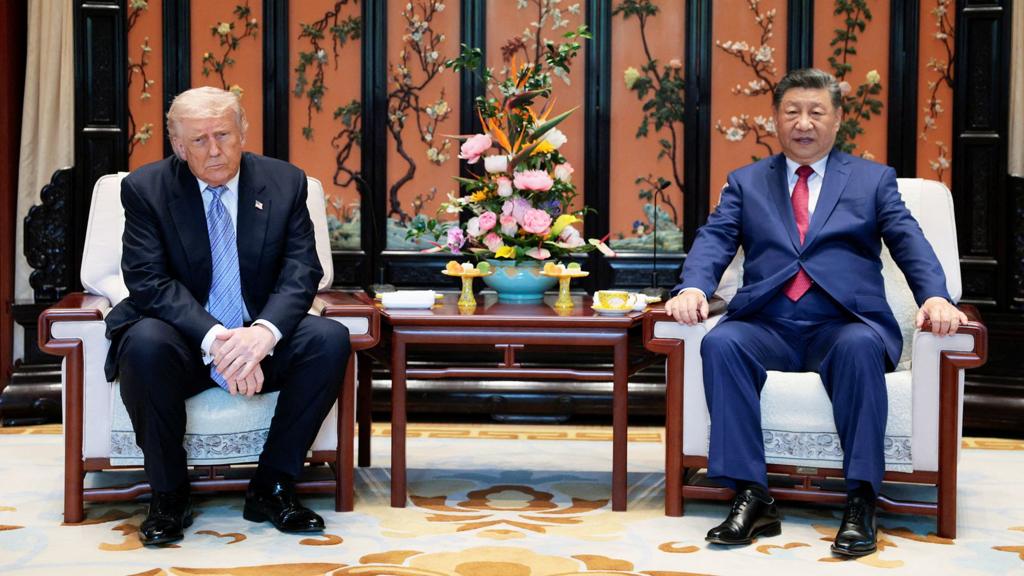
On the final day of President Trump’s two‑day visit to Beijing, the two leaders posed for photographs amid rows of officials, shaking hands before a row of flags. Yet, after two days of choreographed ceremonies, no concrete trade agreement was announced, leaving observers to wonder whether the performance was merely symbolic.
While the visual choreography suggested cooperation, the absence of any signed agreement underscores a deeper strategic divergence. Both leaders seek to project stability to domestic audiences, yet their underlying objectives remain divergent: Trump seeks to extract concessions on trade and technology, while Xi aims to preserve the status quo and safeguard China’s technological ambitions. The lack of a deal reflects the entrenched mistrust stemming from the 2018‑2020 trade war, where tariffs and investment restrictions have become entrenched tools of policy, and the U.S. push for a “decoupling” of critical technologies, especially semiconductors, clashes with Beijing’s desire to maintain access to Western markets and capital.
Underlying the choreography is a broader strategic competition. The United States continues to view China’s rise as a challenge to its technological leadership, while Beijing views U.S. pressure as an attempt to contain its rise. This rivalry influences everything from supply‑chain realignment to the contested Taiwan Strait, and it shapes the broader geopolitical calculus of allies and partners worldwide. The summit occurred against a backdrop of shifting global alignments: Europe seeks to reduce dependence on both powers, while developing nations grapple with the choice between competing spheres of influence. Climate commitments, though mentioned, remain largely symbolic, highlighting the limited convergence on broader governance issues.
Looking ahead, the summit suggests that both sides recognize the costs of escalation, yet the underlying strategic rivalry remains. Future negotiations will likely focus on incremental steps rather than sweeping breakthroughs, indicating that the rivalry will persist, albeit with occasional diplomatic overtures that may soften tensions without altering the fundamental competition. Such a calibrated approach may buy time for diplomatic groundwork, yet it also risks entrenching the status quo if substantive reforms are delayed.