Back to home
INTERNATIONAL30 April 2026
Trump Signals Potential Troop Reductions in Germany, Prompting Berlin’s Sharp Rebuke
Former President Donald Trump announced a review of U.S. troop levels in Germany, sparking a sharp rebuke from German politician Friedrich Merz over Washington’s approach to Iran. The potential cut raises questions about NATO cohesion and Europe’s strategic autonomy.
La
La Rédaction
The Vertex
5 min read
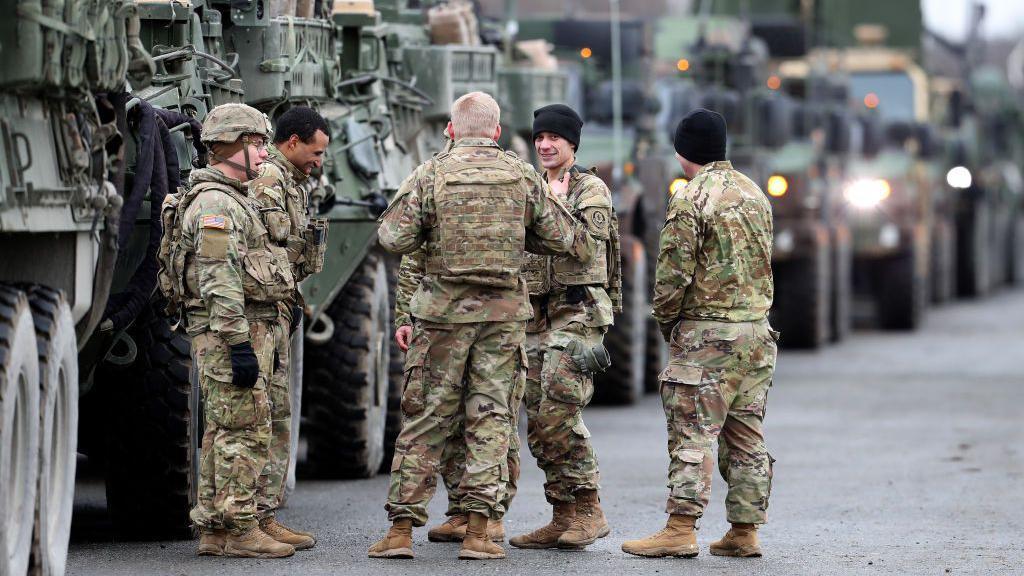
Source: www.bbc.com
In a terse statement that reverberated through transatlantic security circles, former President Donald Trump announced that the United States is currently reviewing the size of its military contingent stationed in Germany, a move that follows sharp criticism from German politician Friedrich Merz over the U.S. posture toward Iran.
The presence of roughly 35,000 American troops in Germany has underpinned NATO’s eastern flank since the Cold War, providing rapid deployment capabilities and a strategic counterweight to Russian aggression. Reducing this force would signal a recalibration of American commitment, potentially emboldening Moscow while testing the alliance’s cohesion. The cost of maintaining these forces, estimated at billions annually, has become a frequent point of contention in U.S. budget debates. Such a reduction could also affect NATO’s ability to respond swiftly to crises in Eastern Europe and the Middle East, raising questions about collective defense commitments.
Merz’s rebuke reflects a growing European skepticism of Washington’s unilateralism, especially after the United States withdrew from the 2015 Iran nuclear agreement and adopted a more confrontational stance. Germany, seeking to assert its own strategic autonomy, views the U.S. approach as destabilizing and at odds with its diplomatic objectives.
If the review culminates in cuts, Berlin may accelerate its own defense modernization and deepen ties with alternative partners, while NATO could face internal debates over burden‑sharing. The development also dovetails with the broader "America First" narrative, suggesting a possible contraction of U.S. overseas footprints ahead of the 2024 election cycle.
Ultimately, the troop‑cut deliberation encapsulates a pivotal moment: whether the transatlantic alliance will adapt to a more multipolar security environment or risk fracturing under divergent strategic priorities. German policymakers are already signaling increased investment in indigenous capabilities, a shift that could reshape the continent’s defense industrial landscape.