Back to home
INTERNATIONAL27 June 2026
Trump’s Face on the 250th‑Anniversary Passport: Symbolism and Sovereignty
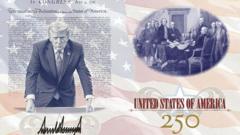
The State Department will issue a limited‑edition passport featuring Donald Trump’s portrait, available only through in‑person applications starting 6 July, to mark the United States’ 250th anniversary. This symbolic move raises questions about national iconography and the role of partisan figures in official symbols.
La
La Rédaction
The Vertex
5 min read
Source: www.bbc.co.uk
As the United States prepares to mark its 250th anniversary in 2026, the State Department announced a limited‑edition passport that will bear the portrait of former President Donald J. Trump.
The special edition, slated for release on 6 July, will be issued only through in‑person applications at designated passport acceptance facilities, a restriction that underscores both the exclusivity of the commemorative item and the logistical challenges of handling a high‑profile design. By featuring a single individual rather than the traditional roster of all presidents, the design raises questions about the criteria for national iconography and the role of partisan figures in official state symbols.
Historically, U.S. passports have displayed a rotating series of presidential portraits, each reflecting the nation’s evolving narrative. The decision to spotlight Trump—whose tenure remains deeply polarising—signals a deliberate attempt to cement his legacy within the fabric of American identity, aligning with the broader commemorative effort that seeks to celebrate continuity and renewal. This move can be read as part of a wider trend in which the current administration leverages heritage narratives to reinforce political capital, even as historians debate the appropriateness of such a singular representation for a nation founded on pluralistic ideals.
Looking ahead, the issuance of Trump‑adorned passports may set a precedent for future commemorative documents, potentially normalising the inclusion of recent political figures in official travel credentials. It also invites scrutiny from international partners, who may view the politicisation of a diplomatic instrument with caution. Whether this symbolic gesture will endure beyond the anniversary year or fade into a footnote of 250th‑birthday memorabilia remains to be seen, but it undeniably foregrounds the intersection of nationalism, celebrity, and statecraft in contemporary America.