Back to home
INTERNATIONAL28 June 2026
Trump’s visage crowns America’s 250‑year passport milestone
A limited run of commemorative passports featuring Donald Trump’s portrait will be issued on 6 July 2026, available only through in‑person applications, marking the United States’ 250th anniversary.
La
La Rédaction
The Vertex
5 min read
Source: www.bbc.co.uk
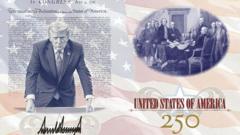
On 6 July 2026, the United States will commence the issuance of a limited series of commemorative passports that prominently feature the likeness of former President Donald Trump, coinciding with the 250th anniversary of American independence.
The decision to place Trump’s face on a national travel document transforms a routine instrument of identification into a potent emblem of partisan politics, signalling a deliberate effort to embed his legacy into the fabric of the nation’s official identity. By restricting applications to in‑person visits at select agencies, the State Department underscores the exclusivity of the edition and reinforces the ceremonial character of the 250th anniversary, while the limited print run suggests a strategic use of the passport as a symbolic artifact rather than a mass‑produced commodity.
Commemorative passports are not unprecedented; the United States has issued special editions for the 1976 Bicentennial and the 1999 Millennium, each serving as diplomatic souvenirs and markers of collective memory. The 250th milestone, occurring in a political climate dominated by Trump’s ongoing influence and coinciding with the 2026 midterm elections, elevates the passport from a mere travel tool to a canvas for national branding, reflecting a broader trend of using state symbols to reinforce ideological narratives and foster patriotic sentiment.
Looking ahead, the Trump‑adorned passport may intensify debates over the politicisation of governmental symbols, especially as the nation approaches a quarter‑century of self‑reflection. Its limited availability could fuel collector interest while prompting scrutiny of how identity politics intersect with everyday bureaucratic processes, suggesting a future where the passport becomes a contested arena of American identity and a barometer of the evolving relationship between the state and its citizens.