Back to home
INTERNATIONAL29 June 2026
Tragedy on the Frontier: Three Firefighters Lost in Expanding Colorado‑Utah Wildfires
Three firefighters died battling a massive blaze that crossed the Colorado‑Utah border, prompting emergency declarations from both state governors. The incident highlights escalating wildfire risks and coordination challenges in the Intermountain West.
La
La Rédaction
The Vertex
5 min read
Source: www.bbc.co.uk
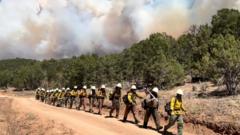
Three firefighters have died while battling a massive wildfire that straddles the Colorado‑Utah border, marking the latest fatality in a series of rapidly expanding blazes that have engulfed parts of both states. The inferno, which has burned thousands of acres across rugged terrain, forced the governors of Colorado and Utah to declare states of emergency as they mobilized additional resources to contain the flames.
The incident underscores the growing complexity of wildfire suppression in the Intermountain West, where shifting wind patterns, prolonged drought, and dense vegetation create conditions for fires that can leap state lines. Coordination between state fire agencies, federal assets such as the U.S. Forest Service, and local volunteers is strained, prompting calls for a more integrated response framework. Moreover, the declaration of emergency statutes accelerates the deployment of aerial tankers and heavy equipment, yet it also raises questions about the adequacy of existing interstate mutual‑aid agreements.
These wildfires fit into a broader pattern of escalating fire seasons in the western United States, driven by climate change and prolonged heat waves. Since the early 2000s, the frequency of fires exceeding 100,000 acres has risen sharply, and the Colorado‑Utah border region has seen a 40 % increase in fire size over the past decade. The human toll—exemplified by the three lost firefighters—highlights the urgent need for improved safety protocols and long‑term landscape management.
Looking ahead, the tragedy may accelerate policy discussions on federal funding for wildfire resilience, expanded training for cross‑border crews, and investment in predictive modeling. If the current trajectory continues, without substantial reforms, the loss of life and ecological damage could outpace the capacity of state and local agencies, underscoring the necessity of a coordinated national strategy that treats fire management as a shared, climate‑driven challenge.