Back to home
INTERNATIONAL28 June 2026
Mandating Biblical Narratives: Texas's School Curriculum Shift Challenges Church‑State Boundaries
Texas has mandated that public school students read selected Bible passages, sparking a debate over religious liberty and the separation of church and state. Critics warn the policy breaches the First Amendment, while supporters argue it provides cultural context.
La
La Rédaction
The Vertex
5 min read
Source: www.bbc.co.uk
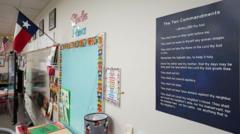
Texas has enacted a law mandating that public school students read selected passages from the Bible as part of the curriculum, a move that has ignited a fierce debate over religious liberty and the separation of church and state. The legislation, signed in early 2026, requires teachers to incorporate biblical narratives into literature and history lessons, arguing that the texts offer valuable cultural and moral context.
Critics, including civil‑rights groups and several religious denominations, contend that the requirement compels students to engage with a particular faith tradition, thereby violating the First Amendment's Establishment Clause. They argue that the policy blurs the line between secular education and religious indoctrination, potentially marginalising students from non‑Christian backgrounds and undermining the neutrality that public schools must maintain. Such a mandate risks eroding the pluralistic ethos that underpins American democracy, as it privileges one religious perspective over others.
The policy fits into a longer American trajectory where courts have repeatedly grappled with the presence of religious material in classrooms. Landmark decisions such as Engel v. Vitale (1962) and Lemon v. Kurtzman (1971) established that state‑sponsored religious instruction is unconstitutional, yet recent legislative efforts in several states suggest a persistent push to re‑introduce biblical content under the guise of historical or literary study.
Looking ahead, the Texas mandate may trigger legal challenges that could reach the Supreme Court, testing the limits of religious accommodation in public education. If upheld, the precedent could embolden similar initiatives elsewhere, reshaping the civic fabric and prompting a national conversation about the role of faith in the public square, while also deepening societal polarization and raising questions about curriculum autonomy.