Back to home
INTERNATIONAL9 July 2026
Escalation in the Shadows: Tehran's Renewed Aerial Campaign Stirs Southern Iran
On 9 July 2026, the United States Central Command announced a strike on ninety Iranian targets, while Iran’s health ministry reported fourteen deaths since Tuesday, highlighting a sharp escalation in southern Iran.
La
La Rédaction
The Vertex
5 min read
Source: www.bbc.co.uk
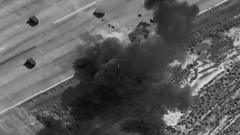
On 9 July 2026, as daylight faded over the rugged terrain of southern Iran, a wave of explosions rippled through several provinces. The United States Central Command announced that its forces had struck ninety Iranian targets in a coordinated aerial campaign, marking a sharp escalation in a conflict that has simmered for years.
Iranian health authorities reported that the blasts have claimed fourteen lives since Tuesday, underscoring the human cost of a strategy that appears designed to degrade Tehran’s strategic assets while avoiding a full‑scale ground incursion. The strikes, which reportedly targeted missile depots, drone factories and air‑defence installations, suggest a shift toward more precise, high‑value objectives. Yet the limited casualty figures also hint at a calculated effort to keep the domestic toll low, a balancing act that may influence public perception of the war.
The operation fits within a broader pattern of Washington’s “maximum pressure” approach, which has combined economic sanctions, cyber intrusions and covert support for regional proxies. By concentrating on southern Iran, where logistical lines are shorter and Iranian air‑defences are comparatively weaker, the campaign seeks to inflict strategic damage without provoking a wider regional conflagration. Nevertheless, the move risks inflaming nationalist sentiment inside Iran and could embolden hard‑line factions that view any foreign aggression as a justification for tighter internal controls.
Looking ahead, the next phase will likely hinge on Tehran’s response. If the regime chooses retaliation through proxy forces or cyber operations, the region may see a rapid escalation. Conversely, diplomatic channels—perhaps mediated by neutral Gulf states—could temper the tempo, turning the strikes into a bargaining chip rather than a prelude to open conflict.