Back to home
INTERNATIONAL5 July 2026
Massive Turnout in Tehran Marks First Day of Ayatollah Khamenei’s Funeral
Thousands gathered in Tehran on the opening day of Ayatollah Ali Khamenei’s funeral, with his body to lie in state at the Grand Mosalla until Monday before being taken across Iran and Iraq. The massive crowd reflects both the regime’s need for public legitimacy and the challenges of transitioning power in a politically fragile Iran.
La
La Rédaction
The Vertex
5 min read
Source: www.bbc.co.uk
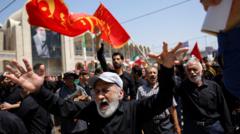
Thousands of mourners flooded the streets of Tehran on the opening day of Ayatollah Ali Khamenei’s funeral, turning the capital into a sea of black and green flags. The massive turnout, captured by state media, underscores the regime’s reliance on public spectacle to legitimize its leadership transition.
The body of the supreme leader will remain in state at Tehran’s Grand Mosalla until Monday, after which it will be transported across Iran and into Iraq for final rites. This itinerary reflects both the symbolic weight of Khamenei’s authority and the logistical coordination required to move a high‑profile corpse through contested border regions.
The crowd’s composition offers clues about the regime’s internal cohesion. Veteran clerics, Basij militia members, and ordinary citizens all converged, suggesting an attempt to present a unified front amid economic hardship and growing dissent. Yet the density of the gathering also reveals the limits of coercion; many participants appeared to be motivated by genuine reverence rather than mere obligation.
Khamenei’s death marks the end of a two‑decade era in which he positioned himself as the guardian of the Islamic Republic’s ideological orthodoxy. His successor, likely a senior cleric with close ties to the Revolutionary Guard, will inherit both the theological legitimacy and the security apparatus that sustained his rule. The funeral’s public nature therefore serves as an early test of the new leadership’s ability to command popular support.
Looking ahead, the scale of mourning may influence Iran’s domestic politics and its regional posture. A strong show of unity could embolden hard‑liners, while any perception of fragility might prompt reformist factions to press for change. The coming weeks will reveal whether the regime can translate ceremonial solidarity into durable political capital.