Back to home
INTERNATIONAL12 July 2026
The Quiet Architect of Qatar’s Energy Empire Passes Away
Sheikh Hamad bin Khalifa Al Thani, who died at 74, transformed Qatar from a modest Gulf sheikhdom into a global gas powerhouse after seizing power in a 1996 bloodless coup. His legacy of energy-driven growth and diplomatic mediation now faces an uncertain future under his successor.
La
La Rédaction
The Vertex
5 min read
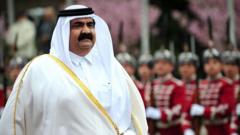
Source: www.bbc.co.uk
Sheikh Hamad bin Khalifa Al Thani, who passed away at the age of 74, died on 12 July 2026, leaving behind a transformed Qatar that he reshaped from a modest Gulf sheikhdom into a dominant player on the world stage.
His 1996 accession, achieved through a bloodless palace coup against his father, restoring dynastic continuity while consolidating his personal authority, enabling a decade‑long consolidation of security institutions and a more assertive foreign policy.
The discovery of the North Field in 1998 and its subsequent development into the world’s largest liquefied natural gas (LNG) export hub turned Qatar’s modest fiscal reserves into a multi‑billion‑dollar economy, financing extensive infrastructure, education, and health systems.
Socially, his reign promoted rapid urbanisation, expanded higher education, and a relatively open cultural policy that attracted expatriate talent, while maintaining a distinct Qatari identity amid increasing global integration.
His departure raises questions about continuity of the energy‑driven model, the balance of US‑Russian‑Chinese diplomatic engagement, and whether his son, the current Emir, will sustain the ambitious trajectory that defined his tenure.
Beyond economics, Sheikh Hamad’s diplomatic outreach—exemplified by Qatar’s mediation in regional disputes and its hosting of major international events—projected the small peninsula onto the global diplomatic stage, reinforcing its reputation as a trusted broker and a hub for soft power.
The transition to his son, Sheikh Tamim bin Hamad Al Thani, signals a continuation of the same developmental blueprint, yet it also introduces generational dynamics and generational expectations that may test the resilience of Qatar’s oil‑and‑gas driven model in an era of energy transition.