Back to home
INTERNATIONAL11 July 2026
A Democratic Congressman’s 90‑Minute Ordeal in the West Bank
U.S. Democratic Congressman Ro Khanna said he was held for 90 minutes by armed Israeli settlers during a West Bank visit on July 11, 2026. The episode highlights settler impunity and may pressure the Biden administration to reassess its support for Israel.
La
La Rédaction
The Vertex
5 min read
Source: www.bbc.co.uk
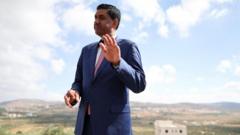
On July 11, 2026, U.S. Democratic Congressman Ro Khanna, 49, recounted being detained for 90 minutes by armed Israeli settlers while touring the occupied West Bank, a rare admission that underscores the volatility of the region and the risks faced by foreign observers. The visit came amid heightened tensions after recent settlement expansion orders.
Khanna’s account, delivered in a recent interview, highlights not only a personal ordeal but also a broader signal of how settler groups operate with impunity, often exploiting the ambiguity of Israel’s de‑facto annexation policies. His detention, which occurred near the settlement of Kiryat Arba, involved a small group of heavily armed individuals who blocked his vehicle, demanded identification, and held him under threat of force before releasing him without formal charges.
The episode fits a pattern in which U.S. legislators who travel to the West Bank are intermittently confronted by settler hostility, reflecting a tension between Washington’s strategic alliance with Israel and growing domestic criticism of settlement expansion. Khanna, a vocal advocate for a two‑state solution, used the incident to call for renewed diplomatic pressure and for the United States to leverage its aid to enforce international law.
Looking ahead, the incident may intensify scrutiny of settler conduct, embolden advocacy groups demanding accountability, and could pressure the Biden administration to reconsider its unconditional support, especially as public opinion in the U.S. shifts toward a more balanced approach to the conflict. If the episode spurs concrete investigations, it could mark a subtle but significant shift in the political calculus surrounding the Israeli‑Palestinian frontier.