Back to home
INTERNATIONAL12 July 2026
Polish Prime Minister Announces Memorial for WWII Victims Described as Ukrainian Nationalist Genocide
Polish Prime Minister Mateusz Morawiecki has announced a permanent memorial to victims of what he calls a ‘genocide’ by Ukrainian nationalists during World War II, reviving a long‑standing dispute with Kyiv over wartime civilian deaths. The pledge highlights the politicisation of historical memory in Central Europe and its potential impact on Poland‑Ukraine relations.
La
La Rédaction
The Vertex
5 min read
Source: www.bbc.co.uk
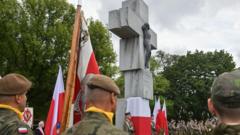
Polish Prime Minister Mateusz Morawiecki announced on Friday that Warsaw will erect a permanent memorial to the victims of what he described as a “genocide committed by Ukrainian nationalists” during the Second World War. The declaration comes amid a long‑standing dispute between Warsaw and Kyiv over the wartime deaths of tens of thousands of civilians, a controversy that has resurfaced as both countries deepen their strategic alignment within the European Union.
Morawiecki’s remarks revive a contentious narrative that frames the Ukrainian Insurgent Army (UPA) and its nationalist affiliates as perpetrators of mass killings against Poles and Jews in 1943‑44. While historians debate the precise scale and intent of these actions, the Polish government insists that the tragedy warrants official commemoration, signalling a shift from diplomatic ambiguity to explicit memorialisation.
The row reflects a broader pattern in Central and Eastern Europe where historical memory is weaponised to serve contemporary political agendas. Since the fall of communism, successive Polish administrations have pursued a narrative of victimhood that aligns with nationalist sentiment, while successive Ukrainian governments have emphasised resistance against both Nazi and Soviet oppression, often downplaying collaborationist elements.
Within the EU, the dispute tests the limits of collective memory as a diplomatic tool. Warsaw’s call for a memorial may strain bilateral cooperation, yet it also resonates with electorates in Poland that view historical injustice as a cornerstone of national identity. The coming months will reveal whether symbolic gestures can translate into durable reconciliation or merely deepen the divide.
Ultimately, the pledge underscores the fragility of post‑war historiography in an era of resurgent nationalism. If implemented, the memorial could become a focal point for future dialogue, but it may also entrench antagonisms, influencing Poland‑Ukraine relations and the broader project of European unity.