Back to home
INTERNATIONAL16 July 2026
A Rare Primate Revealed: The Orange‑Lipped Monkey of Congo’s Hidden Forests
Scientists have identified a new monkey species with vivid orange lips hidden in the remote rainforests of the Democratic Republic of Congo. The find, made in the Lomami River basin, underscores both the region’s underexplored biodiversity and the challenges of conservation in a politically fragile zone.
La
La Rédaction
The Vertex
5 min read
Source: www.bbc.co.uk
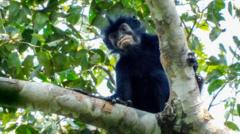
In the remote rainforests of the Democratic Republic of Congo, a team of primatologists has just announced the identification of a previously unknown monkey species distinguished by striking orange lips. The discovery, made in the Lomami River basin—a dense, poorly accessed area where earlier surveys recorded only fleeting vocalizations—offers a rare glimpse into a hidden corner of global biodiversity and has sparked a palpable sense of wonder among the researchers.
The animal, provisionally named *Cercopithecus aurantiacus*, was observed only a handful of times, each encounter described by the scientists as an “amazing feeling” when looking into its face, a reaction that underscores how little humanity has actually known about this creature. Morphological examinations reveal a compact body, a long tail, and unique facial pigmentation that sets it apart from all known congeners, suggesting an independent evolutionary trajectory. Preliminary genetic sequencing indicates a divergence time of roughly two million years from its nearest relative, the blue‑faced guenon, hinting at a long‑isolated lineage.
Its emergence places the DRC at the heart of a growing list of newly described primates from the Congo Basin, a region long hampered by logistical challenges and political instability. Historically, the basin has yielded only a few new primate taxa in the past decade, making this find proportionally significant within global mammalian taxonomy and highlighting the urgent need to map undocumented species before they vanish.
What lies ahead remains uncertain; the limited sightings suggest a shy, possibly elusive population, making rigorous monitoring essential. Conservationists hope the publicity will bolster protection of the forest corridors that shelter *C. aurantiacus*, while researchers plan genetic studies to clarify its phylogenetic position. If confirmed as distinct, the orange‑lipped monkey could become a flagship species for regional preservation, linking local community engagement with international climate commitments.