Back to home
INTERNATIONAL11 July 2026
The $3 Million Enigma: Unpacking the Havana Syndrome Payout
The United States has allocated $3 million to compensate diplomats and officials suffering from the unexplained “Havana Syndrome,” a condition that has afflicted U.S. personnel and families for a decade. The payout highlights both the human cost of the mystery and the growing political and scientific scrutiny surrounding it.
La
La Rédaction
The Vertex
5 min read
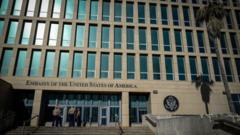
Source: www.bbc.co.uk
For the past ten years, senior U.S. officials, their diplomatic envoys and even family members have been haunted by an unexplained ailment that manifested as intense headaches, dizziness and, in some cases, lasting cognitive deficits.
The mystery, later dubbed “Havana Syndrome,” spread from Cuba to China and led to a series of inconclusive investigations, prompting speculation about acoustic weapons, electromagnetic attacks, or exotic diseases.
In a rare concession, the U.S. government has now earmarked $3 million to compensate victims, signalling both acknowledgement of the problem and a tentative step toward resolution.
The financial payout, while modest in the context of national budgets, underscores the human cost of a condition that has eroded trust in overseas postings and strained diplomatic relations.
Politically, the episode has intensified scrutiny of the State Department’s health‑care provisions and raised questions about whether adequate safeguards exist for personnel deployed in volatile regions.
Economically, the compensation reflects an emerging market for “brain‑injury” claims among intelligence agencies, potentially influencing future budgeting for medical support.
Socially, families of affected diplomats have campaigned for recognition, highlighting the personal toll of invisible injuries and the stigma of being labeled “hysterical.”
The Havana Syndrome fits into a longer pattern of alleged covert attacks on foreign embassies, from the 1970s “Microwave” incidents to recent reports of sonic weapons in Havana.
Each episode has prompted diplomatic protests, intelligence assessments, and, increasingly, public outcry demanding transparency.
As the U.S. begins to fund research into neurological damage linked to these events, the prospect of a coordinated scientific response grows, but so does the risk of politicising health data.
The coming years will likely reveal whether the $3 million is a symbolic gesture or the first step toward a comprehensive policy that protects those who serve abroad.
The $3 Million Enigma: Unpacking the Havana Syndrome Payout