Back to home
INTERNATIONAL14 June 2026
A Precarious Balance: Israeli Strike in Beirut Underscores Lebanon’s Fragile Sovereignty
An Israeli airstrike on a Beirut suburb killed three civilians, raising tensions between Israel and Iran‑backed Hezbollah at a time when US‑Iran nuclear talks are fragile. The incident highlights Lebanon’s struggle to assert state authority amid regional proxy conflicts.
La
La Rédaction
The Vertex
5 min read
Source: www.bbc.com
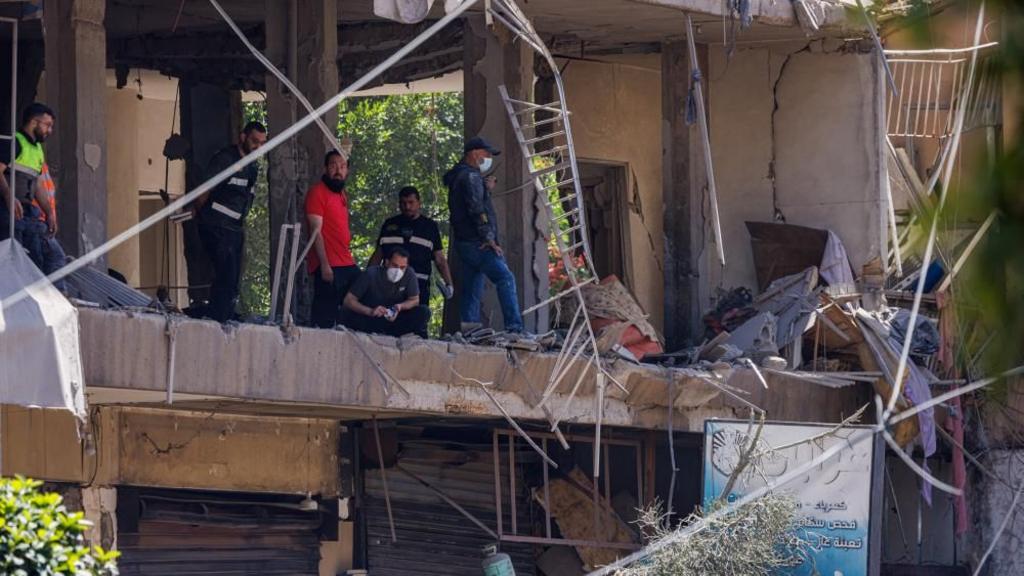
Lebanese authorities reported that an Israeli airstrike on the Beirut suburb of Bir Hassan on Tuesday killed three civilians, including a child, and wounded several others. The casualties were taken to a nearby hospital, where they received treatment for minor injuries, highlighting the human cost of a conflict that has lingered for decades.
From a political standpoint, the incident revives internal Lebanese tensions between the state and the Iran‑backed Hezbollah militia, whose armed presence has long strained the country’s fragile sovereignty. Israeli officials framed the operation as a pre‑emptive strike against a “terrorist hub,” while Tehran condemned it as a violation of Lebanese territorial integrity, warning that such actions could derail the nascent United States‑Iran negotiations aimed at curbing the nuclear standoff. The strike follows a series of intelligence reports suggesting Hezbollah was preparing to launch rockets from Lebanese territory, prompting Israel to act preemptively.
Since the 2006 war, Israel has intermittently conducted cross‑border raids to degrade Hezbollah’s arsenal, but the current escalation occurs against a backdrop of a stalled US‑Iran nuclear deal and heightened proxy competition in the Levant. The United States, seeking to prevent a wider regional war, has urged restraint, whereas Iran has signaled willingness to respond proportionately to avoid undermining its diplomatic overtures. Moreover, the broader regional alignment—Saudi Arabia, the United Arab Emirates, and other Gulf states—has been watching closely, aware that any flare‑up could reverberate across their own security calculations.
Looking ahead, the strike may embolden Hezbollah to accelerate its own missile activities, risking a reciprocal escalation that could complicate any US‑Iran rapprochement. For Lebanon, the incident underscores the limited capacity of the central government to control armed factions, heightening the risk of renewed instability in a nation already grappling with economic collapse and political deadlock. International observers warn that without a coordinated diplomatic framework, the incident may become a flashpoint that drags Lebanon deeper into the shadow of the Iran‑Israel rivalry.