Back to home
INTERNATIONAL2 March 2026
The Hermit Kingdom Heir Apparent?: Unpacking the Kim Dynasty's Future
Kim Jong-un's daughter, Kim Ju-ae, has made increasingly public appearances, sparking speculation about her potential as the next leader of North Korea. The situation raises questions about the Kim dynasty's future, the DPRK's patriarchal society, and international reactions to a female leader.
La
La Rédaction
The Vertex
5 min read
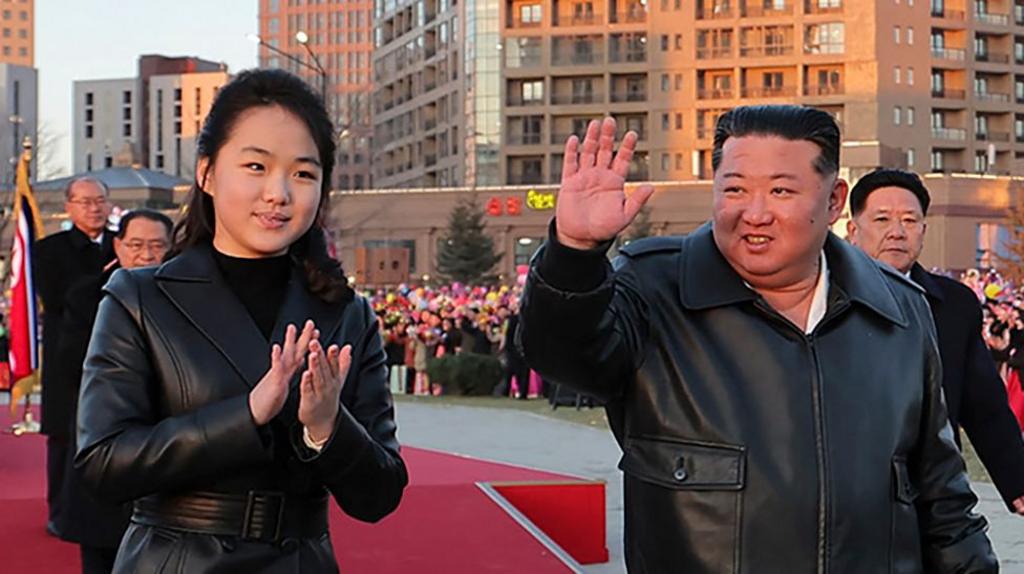
Source: www.bbc.com
The image is stark: Kim Jong-un, Supreme Leader of North Korea, a man whose visage is synonymous with nuclear brinkmanship and iron-fisted rule, accompanied by his young daughter, Kim Ju-ae. These carefully curated public appearances, showcasing a father-daughter bond amidst military parades and missile launches, have ignited a global debate: is Ju-ae being groomed as the next leader of the Democratic People's Republic of Korea (DPRK)?
The question, while seemingly straightforward, unlocks a Pandora's Box of considerations regarding North Korea's opaque power structures, its dynastic political model, and the broader geopolitical implications of a female successor. To understand the potential for Ju-ae's ascent, one must first delve into the history of the Kim dynasty, a lineage built on personality cults, Juche ideology (self-reliance), and ruthless consolidation of power.
Kim Il-sung, the grandfather of the current leader, established the DPRK in 1948, skillfully navigating the complexities of the Cold War and emerging as a figurehead of anti-imperialist resistance. His son, Kim Jong-il, inherited the mantle in 1994, a transition marked by economic hardship and famine. Both transitions were carefully orchestrated, cementing the Kim family's divine right to rule. Kim Jong-un's succession, following his father's death in 2011, further solidified this dynastic pattern.
However, Kim Jong-un's reign has been marked by a distinct shift in style. While maintaining the iron grip on power, he has projected an image of a more modern leader, albeit one just as committed to nuclear armament. The public visibility of his daughter, Ju-ae, is a striking departure from the secrecy that typically shrouds the Kim family's personal lives. This unprecedented exposure fuels speculation about her potential role in the future leadership structure.
Several factors contribute to this intense speculation. First, the Kim dynasty, while outwardly communist, operates more like a monarchy. The concept of hereditary succession is deeply ingrained in the nation's political culture. Second, Kim Jong-un's health has been subject to rumors and speculation in recent years, raising questions about the long-term stability of his rule and highlighting the need for a clear successor. Third, the DPRK's pursuit of nuclear weapons has elevated its significance on the global stage necessitating a clear line of continuity in leadership to maintain its bargaining power.
Yet, the path to succession is fraught with obstacles. North Korea's deeply patriarchal society presents a significant challenge for a female leader. The military, a powerful force within the DPRK's political landscape, may resist the idea of a woman as Supreme Commander. Furthermore, there is the question of Kim Jong-un's other children. While Ju-ae is the most visible, the existence of other potential heirs cannot be discounted.
Beyond the internal dynamics of the DPRK, the international community's response to a female leader also warrants consideration. Would neighboring countries, such as South Korea and Japan, perceive a female leader as a sign of potential change, perhaps opening doors for dialogue and diplomacy? Or would they view it as merely a continuation of the Kim dynasty's authoritarian rule, maintaining the status quo of nuclear tension?
Ultimately, the question of whether Kim Ju-ae will become North Korea's next leader remains unanswered. Her increased visibility is undoubtedly significant, but it is crucial to avoid simplistic conclusions. The DPRK is a complex and unpredictable state, and the inner workings of its leadership remain largely obscured from the outside world.
Looking forward, several scenarios are possible. Ju-ae could be formally designated as Kim Jong-un's heir, undergoing extensive training and grooming to solidify her position. Alternatively, she could be positioned as a symbolic figurehead, a representation of the Kim dynasty's enduring legacy, while actual power remains in the hands of a collective leadership or a male successor. Or, her public appearances could simply be a tactic to project an image of stability and continuity amidst a turbulent geopolitical landscape. Only time will tell what the future holds for the ‘Morning Star Princess’ of Pyongyang. What is certain, however, is that the world will continue to watch closely, hoping that the next chapter in North Korea's history is one of peace and de-escalation rather than further escalation and isolation. The stakes, after all, could not be higher.