Back to home
INTERNATIONAL24 June 2026
Navigating Tensions: UN Evacuation and Rubio's Toll Ban
The United Nations announced it will evacuate foreign sailors stranded in the Strait of Hormuz after an Iranian seizure of a merchant vessel, while Secretary of State Marco Rubio warned Tehran that no tolls may be levied on ships transiting the waterway.
La
La Rédaction
The Vertex
5 min read
Source: www.bbc.co.uk
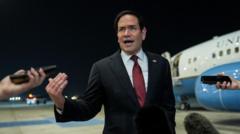
On 23 June 2026, the United Nations announced it would begin evacuating foreign sailors trapped in the Strait of Hormuz after an Iranian patrol seized a merchant vessel, leaving its crew stranded for days. Secretary of State Marco Rubio warned Tehran that “no country can charge fees for ships to travel through the strait,” reaffirming the principle of freedom of navigation under international law.
Rubio’s warning highlights a strategic contest over the strait, through which roughly a fifth of global oil transits. By invoking the United Nations Convention on the Law of the Sea, the United States seeks to block Iran from using maritime commerce as leverage, while signaling to allies that it will safeguard shipping lanes irrespective of Tehran’s posturing. The statement also reflects domestic political pressure, as Congress considers legislation to codify toll prohibitions.
The United Nations’ evacuation plan represents a rare multilateral response to a localized maritime crisis. Since the 1979 Islamic Revolution, the Hormuz has been a flashpoint for Iranian threats to close the waterway, prompting naval standoffs and occasional mining incidents. By coordinating the rescue, the UN demonstrates a willingness to act beyond diplomatic protest, though its limited resources underscore the fragility of regional security mechanisms.
Looking ahead, the episode may intensify diplomatic friction if Iran attempts to impose informal levies on passing vessels, risking broader sanctions and disruptions to global supply chains. Should the UN establish a monitoring framework, it could become a template for crisis management in other contested chokepoints, reinforcing the principle that maritime routes must remain free of monetary coercion.