Back to home
INTERNATIONAL6 July 2026
Massive Turnout in Tehran Reveals Regime’s Resilience at Khamenei’s Funeral
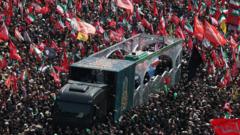
Huge crowds filled Tehran’s streets on July 6, 2026, as the nation escorted Ayatollah Ali Khamenei’s body to his final resting place, waving Iranian flags and red banners of vengeance. The massive turnout underscores the regime’s capacity to mobilize popular support during a critical leadership transition.
La
La Rédaction
The Vertex
5 min read
Source: www.bbc.co.uk
Massive crowds surged through Tehran’s avenues on July 6, 2026, as the nation escorted the body of Ayatollah Ali Khamenei, the former supreme leader, to his final resting place. The procession, which began at the capital’s main mosque and wound through the historic bazaar district, turned the city into a sea of Iranian flags and crimson banners that invoked "vengeance for the former supreme leader's war death."
From a political standpoint, the outpouring of demonstrators signals the regime's capacity to marshal popular support at a moment of leadership transition. The red banners, echoing the rhetoric of martyrdom that underpinned the 1980-88 Iran-Iraq war narrative, reinforce the ideological continuity the clerical establishment seeks to project. Economically, the event demanded extensive security deployment, logistical coordination, and state-sponsored media coverage, diverting resources that could otherwise address pressing domestic challenges such as inflation and unemployment. Socially, the participation of citizens across age groups and regions illustrates the enduring power of the revolutionary mythos to bind a heterogeneous populace.
Khamenei's ascension in 1989 followed the death of Ayatollah Khomeini, whose own funeral in 1989 drew comparable masses and set a precedent for using collective mourning as a tool of political legitimation. The current ceremony therefore operates within a longer historical arc in which the Islamic Republic has repeatedly leveraged funerals of its founding figures to consolidate authority, manage dissent, and project strength abroad, especially amid heightened tensions with the United States and regional rivals.
Looking ahead, the scale of the public response will serve as an early indicator of how the next leadership cadre will be received. A sustained display of loyalty may reassure hard-liners and foreign partners of continuity, whereas a waning turnout could expose fissures, particularly if economic grievances and calls for reform intensify in the months to come.