Back to home
INTERNATIONAL1 July 2026
Firefighters Struggle to Contain Deadly Greek Wildfire
A massive wildfire near Thessaloniki, Greece, ignited on June 30, 2026, has already killed at least two people and forced the evacuation of nearby villages. Over one hundred firefighters, supported by aerial bombers, battle the blaze amid rugged terrain and severe weather, highlighting the growing challenges posed by climate driven heatwaves.
La
La Rédaction
The Vertex
5 min read
Source: www.bbc.co.uk
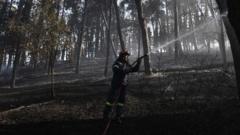
On the evening of June 30, 2026, more than one hundred firefighters converged on a fast moving blaze ignited near Thessaloniki, Greece, where the inferno has already claimed at least two lives—a civilian and a firefighter—while the fire, fanned by strong northerly gusts, has burned over 15 hectares of dense pine forest.
The rugged terrain and shifting wind patterns present formidable obstacles, forcing crews to operate in hazardous conditions with limited water supplies; despite the deployment of aerial water bombers and coordinated ground units, the steep valleys hinder access and strain the limited resources of the national fire service, which has faced budget constraints in recent austerity measures, and the blaze has forced the evacuation of nearby villages, disrupted local tourism, and raised health concerns due to deteriorating air quality in Thessaloniki.
Greek authorities attribute the rapid spread to an unusually dry spring and record high temperatures this year, factors that have amplified the frequency and intensity of wildfires across the Mediterranean basin; the disaster echoes a series of destructive fires in the past decade, such as the 2021 Evia blaze and the 2023 Attica fire, both linked to climate driven heatwaves and prolonged droughts, and has reignited debate over the adequacy of Greece’s early warning systems, which have been criticized for delayed alerts.
Experts warn that without substantial reforms in land use planning, forest management, and climate mitigation, the frequency of such catastrophes will likely rise, challenging the resilience of both municipal and national emergency services and underscoring the urgent need for adaptive policies that integrate ecological preservation with community safety.