Back to home
INTERNATIONAL12 March 2026
China's Legislative Summit: Power Consolidation and Economic Signals
China's National People's Congress concluded with Xi Jinping's power further consolidated, modest economic targets set, and an assertive foreign policy stance reaffirmed. The meeting signals a leadership prioritizing control and strategic autonomy amid domestic and international challenges.
La
La Rédaction
The Vertex
5 min read
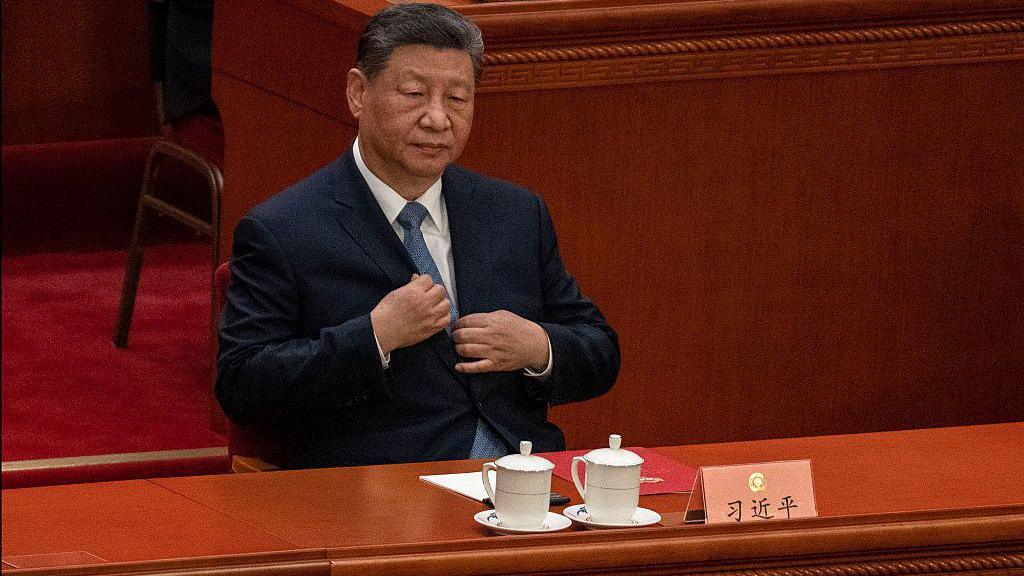
Source: www.bbc.com
The conclusion of China's National People's Congress (NPC) has offered a revealing glimpse into the country's political trajectory under Xi Jinping's continued leadership. The annual gathering, often described as a rubber-stamp parliament, has nonetheless served as a crucial platform for signaling Beijing's priorities amid mounting domestic and international challenges.
Central to this year's proceedings was the further consolidation of Xi's authority. Constitutional amendments passed with overwhelming support effectively remove term limits, allowing Xi to potentially remain in power indefinitely. This move, while not unexpected, represents a significant departure from the collective leadership model that characterized China's post-Mao era. Analysts suggest this centralization of power could lead to more decisive policymaking but also raises concerns about the risks of unchecked authority.
Economically, the NPC set a modest GDP growth target of around 5%, reflecting the government's acknowledgment of persistent headwinds including sluggish consumer spending, a property sector crisis, and ongoing tensions with the United States. The emphasis on technological self-reliance, particularly in semiconductors and artificial intelligence, underscores China's determination to reduce dependence on Western technology amid export controls and sanctions.
On the international front, the congress reinforced China's assertive stance on Taiwan and its claims in the South China Sea. The appointment of a new foreign minister known for his hawkish rhetoric signals a continuation of Beijing's uncompromising diplomatic approach. Meanwhile, the absence of significant stimulus measures has disappointed some investors hoping for a more aggressive economic recovery plan.
As China navigates these complex challenges, the NPC's outcomes suggest a leadership increasingly focused on stability, control, and long-term strategic goals over short-term economic gains. The implications of these choices will reverberate far beyond China's borders, shaping the global geopolitical and economic landscape for years to come.