Back to home
INTERNATIONAL3 July 2026
A Deadly Echo in Damascus: The Café Bombing and the Fragile Cease‑fire
A bomb exploded in a Damascus café near the Palace of Justice on July 3, killing nine people, according to Syrian state media. No group has claimed responsibility, but the attack threatens the fragile cease‑fire and highlights lingering security vulnerabilities.
La
La Rédaction
The Vertex
5 min read
Source: www.bbc.co.uk
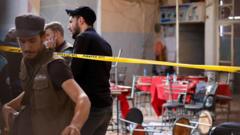
At dawn on July 3, 2026, a bomb exploded inside a modest café on the street beside the Palace of Justice in Damascus, killing nine people and injuring several others, according to Syrian state media.
The attack occurred just weeks after a fragile cease‑fire took hold, prompting questions about the durability of the de‑escalation. No group has claimed responsibility, but analysts suspect anti‑government militias or remnants of the Islamic State, both of which have historically targeted symbolic sites to destabilise the state.
Beyond the casualty figure, the café served as an informal hub for lawyers, officials and ordinary citizens, offering a rare space for civilian interaction in a city where public life is heavily monitored. Its destruction may deter foreign investors still wary of security risks and could trigger a short‑term rise in security spending that strains a strained fiscal budget.
Historically, bombings of cafés and markets have been used to signal terror and to pressure the authorities, echoing the 2013 attacks that shook Damascus. The current blast fits a pattern where the state leverages violence to justify tighter security measures and to reinforce its narrative of control. The state‑run news agency Xinhua's report, echoed by domestic outlets, framed the blast as a terrorist act, aiming to consolidate public support for security crackdowns.
Looking forward, the incident may accelerate the militarisation of public spaces in Damascus, with checkpoints and surveillance expanding into civilian areas. Whether this escalation becomes a lasting shift or a temporary spike will depend on the regime’s response and the broader dynamics of the Syrian conflict.