Back to home
INTERNATIONAL11 July 2026
China Prepares for Dual Typhoon Threat as Bavi Nears Eastern Coast
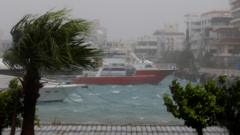
Hundreds of thousands of residents in eastern Zhejiang are being evacuated as Typhoon Bavi, the second storm to hit China in a week, approaches the coast near Wenzhou.
La
La Rédaction
The Vertex
5 min read
Source: www.bbc.co.uk
China is on high alert as Typhoon Bavi, the second severe storm to strike the country within seven days, draws near to the eastern seaboard. Hundreds of thousands of people are being evacuated from Zhejiang province, with the coastal city of Wenzhou situated directly in the projected path. Authorities have mobilised military assets and transport fleets to move residents to safer inland areas, underscoring the scale of the response.
The evacuation reflects both the immediacy of the threat and the chronic vulnerability of China’s densely populated coastal zones. Economic activity in Zhejiang, a hub for manufacturing and export-oriented industries, faces disruption as supply chains are strained and ports may be forced to close. Moreover, the rapid succession of typhoons raises questions about the resilience of infrastructure built for a historically less volatile climate, especially as climate models suggest an increase in extreme weather events.
Contextually, this episode follows the earlier impact of Typhoon Aghavan, which already caused power outages and flooding in southern provinces. The Chinese government’s disaster management apparatus, centred on the Ministry of Emergency Management, has been refining its protocols, yet the sheer volume of people involved tests the limits of coordination and communication.
Looking ahead, the dual‑typhoon scenario may accelerate Beijing’s push for climate‑adaptation measures, including upgraded building codes and more robust early‑warning systems. If the storms cause significant damage, the incident could also influence policy debates on coastal development and insurance schemes, shaping the nation’s approach to risk in an era of escalating climatic uncertainty. The coming weeks will be a litmus test for both public preparedness and the effectiveness of central coordination.