Back to home
INTERNATIONAL5 July 2026
Australian Authorities Hunt for Source of Unexplained Space Debris on Queensland Shoreline
Australian officials are puzzling over six metallic objects that washed ashore on Forrest Beach, sparking a multi‑agency investigation into their origin. The incident highlights growing concerns about space debris re‑entry and the need for stronger global tracking mechanisms.
La
La Rédaction
The Vertex
5 min read
Source: www.bbc.co.uk
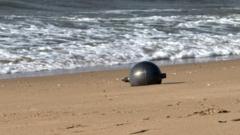
Officials in Queensland are puzzling over six metallic objects that washed ashore on Forrest Beach, a remote stretch of coastline near the town of Seventeen Seventy. The pieces, described as spherical and roughly the size of a basketball, were discovered by a local resident on 3 July 2026 and have since prompted a coordinated inquiry by the Australian Space Agency, the Department of Defence and local police.
Preliminary examinations suggest the objects are made of heat‑resistant alloy and show signs of re‑entry stress, indicating they may be fragments of a defunct satellite or a spent rocket stage. While the exact provenance remains unconfirmed, experts note that the rapid descent of such debris is becoming more common as low‑Earth‑orbit constellations proliferate. The incident underscores gaps in current debris‑tracking mechanisms and raises questions about the responsibility for mitigating objects that re‑enter uncontrolled.
Australia is not alone in confronting unexpected space debris; similar events have been recorded along the coasts of Spain, Japan and the United States in recent years. These occurrences coincide with the launch of mega‑constellations for broadband internet, which increase the probability of uncontrolled re‑entry. International frameworks such as the Inter‑Agency Space Debris Coordination Committee (IADC) guidelines have yet to be universally adopted, leaving national authorities to navigate a patchwork of responsibilities.
The Australian inquiry will likely culminate in a report that recommends enhanced monitoring, stricter licensing conditions for satellite operators, and possibly new legislation to enforce end‑of‑life disposal. If the debris proves to be from a commercial constellation, it could accelerate diplomatic discussions on shared accountability in space. Ultimately, the episode may serve as a catalyst for a more robust global governance structure, ensuring that the spectacle of celestial objects does not become a hazard for coastal communities.