Back to home
INTERNATIONAL6 May 2026
The Second‑Largest Megatsunami on Record: Alaska’s Hidden Earthquake Trigger
A recent analysis shows that a series of tiny earthquakes triggered a massive landslide, producing the second‑largest megatsunami ever recorded in Alaska. The event highlights growing vulnerability in remote Arctic regions and the need for improved early‑warning systems.
La
La Rédaction
The Vertex
5 min read
Source: www.bbc.com
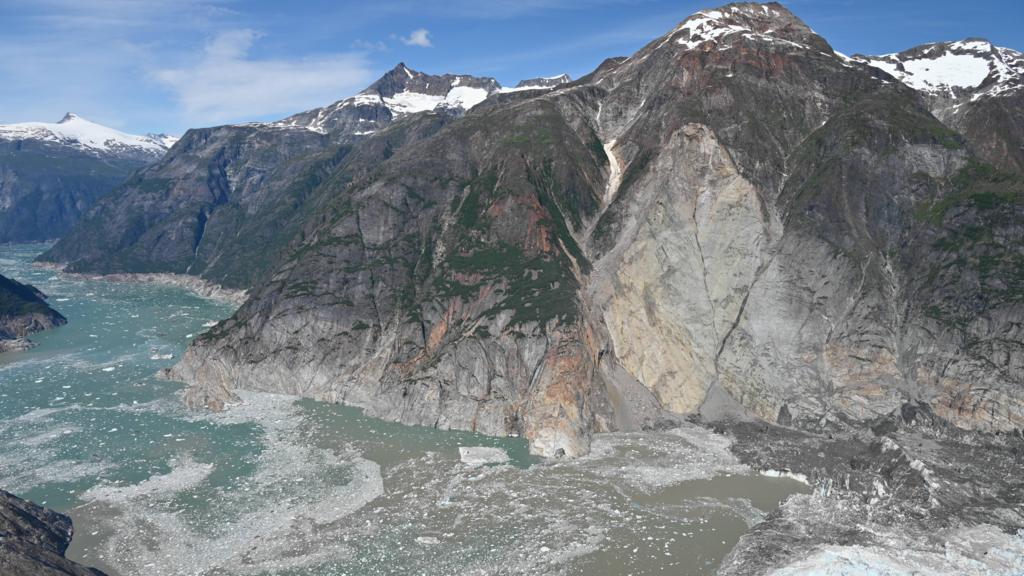
On a quiet night in July 2021, a remote Alaskan fjord was shattered by a wall of water that surged 300 meters inland, leaving a scar of debris and reshaping the coastline. The event, initially dismissed as a freak occurrence, has now been identified as the second‑largest megatsunami ever documented, according to a recent peer‑reviewed analysis.
Scientists traced the catastrophe to a cascade of micro‑earthquakes that destabilized a steep mountain slope above the inlet. The seismic tremors, each under magnitude 2, collectively reduced friction and triggered a landslide that plunged 150 million cubic meters of rock and ice into the water, generating the towering wave.
The wave’s energy dissipated over 10 kilometers, inundating coastal ecosystems, destroying infrastructure, and prompting emergency evacuations of remote villages. Economically, the incident underscores the vulnerability of Alaska’s resource‑dependent communities to sudden, low‑probability hazards, challenging existing risk‑assessment models.
This event fits into a broader pattern of climate‑induced destabilizations in high‑latitude regions, where thawing permafrost and glacial retreat increase landslide susceptibility. Historical records show only a handful of megatsunamis exceeding 300 meters, making Alaska’s incident a rare natural laboratory for geophysical research.
The analysis, published in a leading geophysical journal, combined satellite interferometry, seismic waveform inversion, and field‑based LiDAR surveys to reconstruct the landslide’s dynamics with unprecedented precision. By quantifying the exact volume of material displaced and the timing of the seismic cascade, the study offers a template for assessing similar events worldwide.
As Arctic warming accelerates, the frequency of such cascading events may rise, demanding updated early‑warning systems and resilient land‑use planning. The Alaska megatsunami thus serves as a stark reminder that even remote, seemingly stable landscapes can become the epicenter of sudden, high‑impact disasters.